Monday, August 13, 2012


Friday, August 10, 2012
Bizarre rock 'ice shelf' found in Pacific, Extraterrestrial Origin: Bizarre Crystal Zipped Here From Outer Space
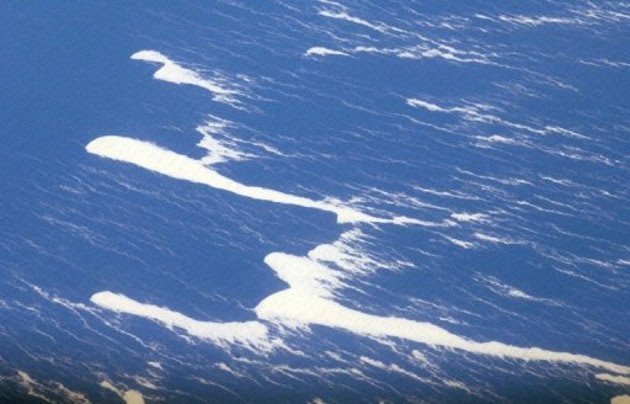
Bizarre rock 'ice shelf' found in Pacific
From Yahoo News:
A huge cluster of floating volcanic rocks covering almost 26,000 square kilometres (10,000 square miles) has been found drifting in the Pacific, the New Zealand navy said Friday.
The strange phenomenon, which witnesses said resembled a polar ice shelf, was made up of lightweight pumice expelled from an underwater volcano, the navy said.
An air force plane spotted the rocks on Thursday about 1,000 kilometres (600 miles) offshore from New Zealand and warned a navy warship that it was heading towards them.
Lieutenant Tim Oscar said that while he knew his ship the HMNZS Canterbury was in no danger from the pumice, which is solidified lava filled with air bubbles, it was still "the weirdest thing I've seen in 18 years at sea".
"As far ahead as I could observe was a raft of pumice moving up and down with the swell," he said.
"The rock looked to be sitting two foot (half a metre) above the surface of the waves and lit up a brilliant while colour in the spotlight. It looked exactly like the edge of an ice shelf."
Scientists aboard the ship said the pumice probably came from an underwater volcano called Monowai, which has been active recently.
They said the phenomenon was unrelated to increased volcanic activity in New Zealand this week, including an eruption at Mount Tongariro that sent an ash cloud 20,000 feet into the atmosphere.
Extraterrestrial Origin: Bizarre Crystal Zipped Here From Outer Space:

A sample of a bizarre crystal once considered unnatural may have arrived on Earth 15,000 years ago, having hitched a ride on a meteorite, a new study suggests.
The research strengthens the evidence that this strange "quasicrystal" is extraterrestrial in origin.
The pattern of atoms in a quasicrystal falls short of the perfectly regular arrangement found in crystals. Until
January, all known quasicrystals were man-made. "Many thought it had to be that way, because they thought quasicrystals are too delicate, too prone to crystallization, to form naturally," study researcher Paul Steinhardt of Princeton University told LiveScience at the time.
Then researchers announced the presence of a natural quasicrystal in a meteorite found in the Koryak Mountains of Russia. . That meteorite was being kept in a museum in Italy. Now, on an expedition to the site where it was found in Russia, Steinhardt and his colleagues now have found more natural samples of quasicrystals for analysis.
Mysterious matter
Quasicrystals were first synthesized in a lab in 1982 by Israeli chemist Dan Shechtman, whose work won the Nobel Prize for Chemistry in 2011. Regular crystals are made up of regular clusters of repeating atoms arranged in particular symmetries. Quasicrystals are orderly, too, but they do not exactly repeat themselves. If regular crystals are like boring bathroom tiles, quasicrystals are like complex tile mosaics.
Steinhardt and his colleagues were long on the hunt for natural quasicrystals. They first saw one in 2008, when Italian mineralogist Luca Bindi of the Museum of Natural History in Florence spotted a tiny quasicrystal grain in a rock sample in the museum's collection.
The researchers reported that find in the journal Science in 2009 and then traced the rock to Russia. An analysis of the rock fragment, published in January in the journal Proceedings of the National Academy of Sciences, concluded that the rock was a meteorite that likely formed in the early solar system more than 4.5 billion years ago, before the Earth existed.
The hunt for quasicrystals
Now Steinhardt and Bindi report in the journal Reports on Progress in Physics that quasicrystal samples are found in an environment that would not have had the extremes needed to create them. The report strengthens the case that the sample rode to Earth on a meteorite.
On their expedition to the Koryak Mountains, the researchers also determined that the samples came to Earth during the last glacial period, about 15,000 years ago.
"The fact that the expedition found more material in the same location that we had spent years to track down is a tremendous confirmation of the whole story, which is significant since the meteorite is of great interest because of its extraordinary age and contents," Steinhardt said in a statement.
The next goal, Steinhardt said, is to figure out the secret of the natural quasicrystals' formation.
"What does nature know that we don't?" he said. "How did the quasicrystal form so perfectly inside a complex meteorite when we normally have to work hard in the laboratory to get anything as perfect? What other new phases can we find in this meteorite, and what can they tell us about the early solar system?"
"At the moment, we are at the tip of the iceberg," Steinhardt added.
Cool but rather somewhat odd news for this early in August :) - Rob
Thursday, August 2, 2012
Two years later, alien-like sea creature gains Internet stardom

By: Pete Thomas, GrindTV.com and Yahoo News
Among the more bizarre-looking visitors to California waters this summer are Mola molas, or ocean sunfish, which are being seen in unusually high numbers. But it's a stunning photograph of one of these gentle giants that appears to be getting the most attention. The image, captured off San Diego by Daniel Botelho, became an instant hit after being posted last week on his Facebook page.
"It got 1,000 'likes' in 36 hours," said Botelho, an award-winning photojournalist who specializes in underwater photography. Through Monday the number of likes and shares beneath had grown to 1,375 and 1,237, respectively.
There was no back story provided but Botelho, when reached via email, explained that he captured this image in July of 2010, while on a blue whale photography mission. But he somehow placed it in a folder of non-used images and did not discover it until recently, while planning another blue whale odyssey.
The Facebook post was the first time the image had been published. "It is so funny, I wasted that image and after two years I found it, posted it, and it becomes viral," Botelho said.
Though molas are docile and appear sluggish, they're difficult to photograph because they're deceivingly swift and do not generally tolerate divers who try to get close.
"There were more than five in the same spot but once I got in the water, as stealthily as I could, they all went out fast," Botelho explained. "But one specific fish stopped to check what I was, and God knows why the fish decided to follow me. People in the boat said it seemed like a dog following his owner."
The photographer in the image had hoped to photograph Botelho next to the sunfish but instead he became the subject to lend perspective as to how large and moon-like molas can be.
The sunfish can measure 14 feet and weigh as much as 5,000 pounds. They're found in tropical and temperate oceans. With their large bodies, truncated tails, tiny mouths, and huge eyes, they look like something not entirely whole and not of this world.
The Monterey Bay Aquarium, in a species description, states: "Ocean sunfish, or molas, look like the invention of a mad scientist."
They feed primarily on jellies but will also eat squid and small fish. Large numbers of jellies and gelatinous creatures called salps this summer may help to explain an increase in sightings made by California boaters.
-- Image is courtesy of Daniel Botelho for use with this story only, and is protected by copyright laws
-http://www.grindtv.com/outdoor/blog
Note: Awesome pic! -Rob
Saturday, July 28, 2012
20 Things You Didn’t Know About Dogs
From: expose-the-light via tumblr:
20 Things You Didn’t Know About Dogs
1 The sultry “dog days of summer” get their name from ancient astronomers who noticed that those days coincide with the period when Sirius, the Dog Star, rises at the same time as the sun.
2 Bad astronomy: Sirius is the brightest star in the sky, but it is just one 10-billionth as bright as the sun and has no effect on our weather.
3 Nerd. Fido will touch his nose to a computer screen if it has a picture of a dog on it but not if it shows a landscape, University of Vienna researchers have found.
4 Austrian scientists have also demonstrated that a dog seems to feel “inequity aversion” when another dog gets a better treat as a reward. The envious dog plays hard to get.
5 South Korean scientists cloned four beagle puppies with a gene that produces a fluorescent protein that glows red under ultraviolet light. (The red color is visible in the pups’ bellies and nails even under normal light, but it doesn’t glow.)
6 Maybe they should have offered a Day-Glo option. BioArts, a California company, recently closed its dog-cloning business. One reason: The market was too small.
7 Another problem: “unpredictable results,” according to BioArts. In one case, the clone of a black-and-white dog came out looking greenish yellow.
8 The number of dogs worldwide is estimated at 400 million, roughly the human population of the United States and Mexico combined.
9 They really do look like their owners. In a study conducted at England’s Bath Spa University, people matching photos of dog owners and dogs chose the right breed (out of three) more than half the time.
10 Half of all owners allow their dogs to lick them on the face, but only 10 percent share E. coli strains with their pets. The real factor in germ transmission may be whether an owner washes his hands after playing fetch.
11 Fighting a hangover by drinking “the hair of the dog that bit you” may have originated in an ancient belief that ingesting the hair of a dog that literally bit you could guard against infection.
12 A 2006 study showed that household dogs with minimal training can smell early- and late-stage lung and breast cancers. Swedish oncologists also found that dogs can distinguish among types of ovarian cancer.
13 A dog’s nose has roughly 220 million olfactory receptors, 40 times as many as humans have.
14 Penn State engineers are trying to design an artificial sniffer based on the fluid mechanics and odorant transport of the canine nose.
15 Dogs can hear frequencies up to 45,000 Hz, about twice as high as humans can. But they’re not the champs: Porpoises go to 150,000 Hz.
16 A team led by UCLA biologists concluded that small dogs descended from Middle Eastern gray wolves more than 12,000 years ago. The connection was traced through a growth-factor gene mutation not seen in larger dogs.
17 Much older canid remains have been found in Germany, Russia, and Belgium, dating as far back as 31,000 years.
18 The reference genome for doggie DNA studies is the boxer, a breed that has an unusually high degree of genetic uniformity.
19 So that’s why schnauzers look like Groucho. According to scientists at the National Human Genome Research Institute, an alteration in one gene, RSPO2, gives dogs wiry eyebrows and mustaches.
20 A variant of another gene, FGF5, produces long, silky coats, and curly hair comes from a mutation in KRT71. All three variants produce a coat like that of the Portuguese water dog adopted by the First Family.
http://discovermagazine.com
Saturday, July 7, 2012
Could We Build 'Star Trek's' Starship Enterprise? Maybe...

The following technology article comes from: could-build-star-treks-starship-enterprise
"Since its first appearance on the original "Star Trek" series in 1966, the starship Enterprise has become a symbol for space travel. Recently, an anonymous engineerclaimed that an approximation of this iconic ship could be built in the next two decades. But just how close is mankind to zipping through the stars at warp speed?
On the website BuildTheEnterprise.org, a self-proclaimed engineer who identifies himself only as "BTE-Dan" suggests that a working facsimile of the iconic ship could be built and launched over the next 20 to 30 years. The ship would require a few modifications, but would look a great deal like Captain Kirk's famous ship.
Built in space, the ship would never visit the surface of any moon or planet, and so would never need to reach the high speeds necessary to escape surface gravity. The engines would be powered by nuclear reactors onboard the ship, and use argon rather than xenon for propellant, saving a few hundred billion dollars in cost. As an added bonus, BTE-Dan notes that argon can be mined from the atmosphere of Mars.
Although such a ship would a lack a warp drive (the technology that allows the "Star Trek" version to zip between stars across the galaxy), it could reach the moon in three days and Mars in three months. BTE-Dan suggests it might function as a combination of a space station and a space port, allowing humans to orbit planets and moons within the solar system while using a "universal lander" to travel to and from their surfaces. Such a spaceship could house 1,000 people within its gravity wheel
The entire ship would be more than 3,000 feet (almost 1 kilometer) long, with its central disk making up nearly half its length.
According to the website, much of the technology needed to build the ship described is within our grasp, including the rotating gravity wheel, which could be suspended by electromagnets within a vacuum to eliminate mechanical wear and tear. Also easily within reach, he claims, are a 1.5 GWe (gigawatt electrical) nuclear reactor safe to carry in a spacecraft, and composite materials that would save mass, add strength and improve radiation shielding.
Design challenges
BTE-Dan describes himself as a systems and electrical engineer who has spent the past 30 years employed at a Fortune 500 company. He is presently declining interviews.
Though the prospect of a real-life Enterprise is appealing, the proposed ship is not without problems.
Adam Crowl, an engineer with Icarus Interstellar Inc., a nonprofit foundation dedicated to interstellar exploration, pointed out that a spaceship built with a sufficiently powerful nuclear reactor would need large thermal radiators, ruining the classic Enterprise look.
"Engineering physics doesn't respect our aesthetics," he told SPACE.com by email.
"I would love to see 1,000 people go to Mars, but I need convincing that they need to be on the Enterprise to do so," said Crowl.
Other engineers said the similarities between BTE-Dan's ship and the Enterprise are only skin-deep.
"He wants to build something using foreseeable technology that just looks like the Enterprise," said Marc Millis, an aerospace engineer at NASA's Glenn Research Center. "It's nowhere close to being what the Enterprise is."
Still, the site received so many visits soon after its launch that it crashed, revealing how appealing the idea is to many people.
Today's technology
Though some aspects of the Enterprise are far out of reach today, many are within our grasp, and some are part of our daily lives. Sliding doors, futuristic in the 1960s, now welcome almost every grocery store visitor, and today's flip-open cellphones resemble Star Trek's tricorders. The touch-screen devices ubiquitous today even look like those used in the 1990s episodes of "Star Trek: The Next Generation."
"If you had shown someone an iPad in the 1990s and told them it was 23rd century technology, they would have believed you," Richard Obousy, co-founder and president of Icarus Interstellar Inc., told SPACE.com.
Advances with 3D printers also provide opportunities for voyages through space, allowing the replication of parts while using materials found at the destination. Andreas Hein, an aerospace engineer also with Icarus Interstellar, suggested that it might not be long before such printers make food similar to the way meals were synthesized by replicators on the Enterprise.
Additionally, engineers working at NASA's Advanced Propulsion Physics Laboratory, informally known as Eagleworks, are working on a Q-thruster that bears a striking resemblance to the impulse engines on the Enterprise.
Nuclear woes
Millis suggested the next step in rocket propulsion will likely include utilizing a nuclear power source, an option that is stymied by the Nuclear Test Ban Treaty. He acknowledged that the barriers aren't just political ones, as people are nervous about the idea of launching nuclear rockets from Earth's surface, despite the fact that it could be done safely.
Obousy agreed that nuclear rockets could provide the necessary thrust, pointing to the large, multibillion-dollar projects around the world seeking ways to unlock fusion as an energy source. Of course, such projects primarily focus on powering homes and cities on Earth, but once unlocked, fusion could be used to travel through the stars.
"In terms of propulsion technology, fusion engines are potentially within a generation or two," Obousy said, though he added that sudden technological jumps could accelerate the process.
"We're doing things with meta-materials that'll allow practical cloaking, maybe even invisibility," Crowl said.
Gravity presents one of the greatest challenges: The Enterprise of television and the movies lacks a gravity wheel, instead utilizing synthetic gravity. According to Millis, if we could find a way to master gravitational forces, such technology could also be utilized in tractor beams or the ship's propulsion.
Warp speed ahead
"Star Trek"-like propulsion remains a key problem. Fans are familiar with the warp drive, which accelerated the ship faster than the speed of light and allowed its crew to zip between stars. Such travel defies our present understanding of physics.
"I think this is one of the most important aspects that prevents an Enterprise-type ship in the near future," Hein said.
Obousy agreed. "One of the staples of these warp drives is that they require an exotic form of energy that we have not been able to create in the labs, dark energy being the salient example," he said.
Dark energy is the unexplained force behind the accelerated expansion of the universe. Scientists don't yet understand what it is, which makes it a challenge to use in propulsion.
A warp drive would require an enormous amount of energy. Theoretical calculations using dark energy to move a starship would require more energy than that contained within the planet Jupiter, making it uneconomical.
In the "Star Trek" universe, the warp drive relied on antimatter. When matter and antimatter annihilate one another, the energy produced is immense. Though such an energy source could conceivably power the ship, it is available only briefly.
Crowl pointed out that antimatter technology itself is developing rapidly. Ultra-high intensity lasers may soon allow it to be directly created from energy, and useful amounts may be trapped in the magnetic fields of planets like Earth and Saturn.
But, like dark energy, antimatter may prove to be more trouble than it's worth.
"Using antimatter right now is very expensive," Millis said. "But that doesn't mean that it always will be."
When mankind finally travels to the stars, we may have to forgo warp speed for something else, such as the manipulation of space-time itself. According to Albert Einstein, nothing in the universe can travel faster than the speed of light. But Millis points out that such limits do not necessarily apply to space-time. Theories in peer-reviewed journals explore the possibility of surrounding a craft with a bubble of space-time that expands and contracts, perhaps allowing it to exceed the speed of light.
"It's the difference between moving a pencil across a piece of paper or moving the whole paper," Millis said.
Beam me up, Scotty
Another potential challenge to recreating the "Star Trek" universe is the system of matter transmission. The crew often traveled to a planet by transporter, beaming from the Enterprise directly to the surface by way of machines that could scan a body, atom-by-atom, and then recreate it in another place.
Recent advances have been made in quantum teleportation, but Obousy and Millis both stressed the difference from "Star Trek"-style travel.
In quantum teleportation, "it's not the same photon you started out with, but a replica," said Obousy.
Such travel would require enormous precision.
"If you were going to recreate a human being transported from one place to another, you'd want to make sure everything's in the exact place," he said.
Millis suggested that, rather than matter transmission, scientists might one day learn how to utilize very small wormholes for travel.
"Of course, if you put mass through it, it might make the wormhole collapse," he noted.
Ultimately, the greatest challenge to replicating the Star Trek journeys may not come from the technological front."One of the things that I really liked about watching [the show] was the very good behavior of the crew," Millis said. "The prejudices and petty human differences that make up so much of television are pretty much absent. When I think about relative impossibilities, I think it will be easier to make technology for the starship Enterprise than to finally make humans behave that honorably."
Visit www.buildtheenterprise.org to see more details on the proposed construction of a real-life Enterprise.
Wednesday, July 4, 2012
Saturday, June 30, 2012
BIGFOOT BAIT!
While cryptozoology enthusiast and 'want-da-be-real Cryptozoologists' guess, ponder, theorize then argue, post redundant posts, fuss over what Bigfoot could be eating and must surely look like, they then go shake a few local bushes, photograph muddy tracks of seldom seen bears, bold raccoons, rushed deer and human made hoaxes - they do this after dumping the cold bitter morning cowboy coffee into the weeds, ignoring an undiscovered frog, toad or lizard that is now drenched in coffee bean juice - they leave the camp for an evening hike, to bait a few areas and set a few trail cam's, as they fasten the cam-strap to the big old oak tree the frightened Ivory-billed woodpecker flees to safety, never noticed, never reported, never documented...
The next morning, with the stealth of a marching band they pack up their equipment, again alerting a curious out-of-place large cat that was resting in a nearby tree, as they return from the woods in a car parked not that far away, they proudly carry a baggie full of coyote poop and hair samples of a neighborhood captive chimp that some damn bird scavenged for last years nest and again listen to last nights tapes of Bigfoot tree knocks, calls and limbs breaking, as they recall a dark shadow that was seen on the distant path...never considering the reality of the sights and sounds - a hunter was placing a new deer stand up for next years hunt and a fox was fighting with a rival and an old lonely fisherman was walking to his favorite late night fishing spot...
For the next two months or decades they stand by their investigation as Bigfoot proof and solid evidence, becoming more sure with each question of doubt they flatly reject...
By: Jerry D. Coleman
How to Tweet to Aliens Tonight - LiveScience and yahoo news
"Don't forget to contact aliens this evening.
All Twitter messages composed between 8 p.m. EDT Friday (June 29) and 3 a.m. EDT Saturday (June 30) tagged with the hashtag #ChasingUFOs will be collectively beamed up to space Aug. 15, toward a spot in the sky from which a possible alien signal originated.
The cosmic tweet is a belated reply to the Wow! signal, a mysterious radio transmission that was detected at the Big Ear radio observatory in Ohio in 1977 coming from the direction of the constellation Sagittarius. At its peak, the 72-second transmission was 30 times more powerful than ambient radiation from deep space, prompting the volunteer astronomer Jerry Ehman to scrawl "Wow!" next to the data on a computer printout, giving the signal its name."
Awesome! :)
Thursday, June 28, 2012
Hell helps keep crime down? Yep...

On the bright side, hell helps keep crime down...
The study’s findings confirm other studies indicating that belief in supernatural punishment has spread across cultures to suppress anti-social behavior.
-First seen on mothernaturenetwork via Tumblr.
Gateway of the Mind
"In 1983, a team of deeply pious scientists conducted a radical experiment in an undisclosed facility. The scientists had theorized that a human without access to any senses or ways to perceive stimuli would be able to perceive the presence of God. They believed that the five senses clouded our awareness of eternity, and without them, a human could actually establish contact with God by thought. An elderly man who claimed to have “nothing left to live for” was the only test subject to volunteer. To purge him of all his senses, the scientists performed a complex operation in which every sensory nerve connection to the brain was surgically severed. Although the test subject retained full muscular function, he could not see, hear, taste, smell, or feel. With no possible way to communicate with or even sense the outside world, he was alone with his thoughts.
Scientists monitored him as he spoke aloud about his state of mind in jumbled, slurred sentences that he couldn’t even hear. After four days, the man claimed to be hearing hushed, unintelligible voices in his head. Assuming it was an onset of psychosis, the scientists paid little attention to the man’s concerns.
Two days later, the man cried that he could hear his dead wife speaking with him, and even more, he could communicate back. The scientists were intrigued, but were not convinced until the subject started naming dead relatives of the scientists. He repeated personal information to the scientists that only their dead spouses and parents would have known. At this point, a sizable portion of scientists left the study.
After a week of conversing with the deceased through his thoughts, the subject became distressed, saying the voices were overwhelming. In every waking moment, his consciousness was bombarded by hundreds of voices that refused to leave him alone. He frequently threw himself against the wall, trying to elicit a pain response. He begged the scientists for sedatives, so he could escape the voices by sleeping. This tactic worked for three days, until he started having severe night terrors. The subject repeatedly said that he could see and hear the deceased in his dreams.
Only a day later, the subject began to scream and claw at his non-functional eyes, hoping to sense something in the physical world. The hysterical subject now said the voices of the dead were deafening and hostile, speaking of hell and the end of the world. At one point, he yelled “No heaven, no forgiveness” for five hours straight. He continually begged to be killed, but the scientists were convinced that he was close to establishing contact with God.
After another day, the subject could no longer form coherent sentences. Seemingly mad, he started to bite off chunks of flesh from his arm. The scientists rushed into the test chamber and restrained him to a table so he could not kill himself. After a few hours of being tied down, the subject halted his struggling and screaming. He stared blankly at the ceiling as teardrops silently streaked across his face. For two weeks, the subject had to be manually rehydrated due to the constant crying. Eventually, he turned his head and, despite his blindness, made focused eye contact with a scientist for the first time in the study. He whispered “I have spoken with God, and he has abandoned us” and his vital signs stopped. There was no apparent cause of death."
-Via poseidonsdick on Tumblr

Monday, June 25, 2012
The Loch Ness Monster used to debunk evolution in state-funded school!
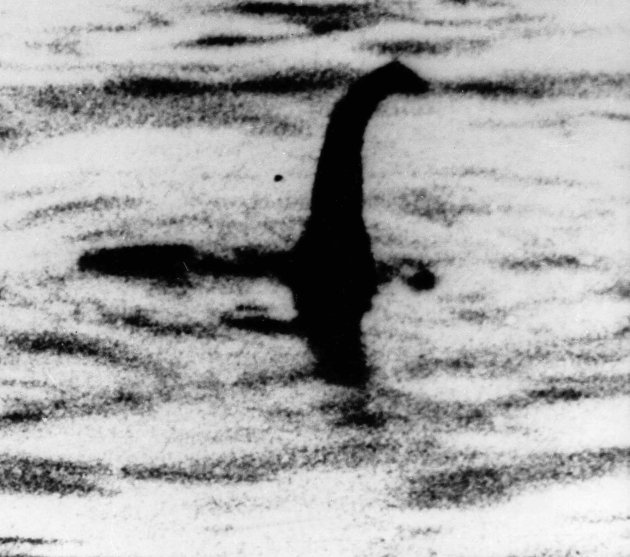 |
| "An alleged photo of the Loch Ness monster in Scotland. (Associated Press)" |
It's true!
"It sounds like a hoax, but it's apparently true: The Loch Ness Monster is on the science class syllabus for kids at Eternity Christian Academy in Westlake, Louisiana.
As reported by the Herald Scotland (which must track all Loch Ness-related news), a school that will receive tax-payer dollars, will teach kids that the mythological sea creature is real in order to debunk the theory of evolution. So pay attention: That will be on the test.
Eternity Christian Academy uses the fundamentalist A.C.E. Curriculum to teach students "to see life from God's point of view."
According to the Herald, one textbook, Biology 1099, reads, "Are dinosaurs alive today? Scientists are becoming more convinced of their existence. Have you heard of the 'Loch Ness Monster' in Scotland? 'Nessie' for short has been recorded on sonar from a small submarine, described by eyewitnesses, and photographed by others. Nessie appears to be a plesiosaur."
Starting in the fall, thousands of schoolchildren will receive publicly funded vouchers to attend private schools, some of which are religious. Religious schools in Louisiana will receive public funding as part of a push from Louisiana's governor, Bobby Jindal, to move millions of tax dollars to cover tuition for private schools, including small bible-based church schools. Money will fund schools that have "bible-based math books" and biology texts that refute evolution.
At Eternity Christian Academy, pastor-turned-principal Marie Carrier says that the her first through eighth-grade students learn at their own pace from Christian workbooks. The beginning science text explains "what God made" on each of the six days of creation. Evolution is not taught.
Carrier said, "We try to stay away from all those things that might confuse our children." She hopes to secure enrollment of 135 voucher students for the 2012-2013 school year. According to the website Salon, the school currently has just 38 students.
Whether this gambit will help move Louisiana from the bottom of math and science rankings in the country is unclear. A 2011 study of how well primary education prepares students for engineering careers had Louisiana third from the bottom, with only West Virginia and Mississippi performing worse." -Yahoo News
Wow.
Subscribe to:
Posts (Atom)