Amazon.com bestsellers list

Saturday, July 7, 2012

Could We Build 'Star Trek's' Starship Enterprise? Maybe...


The following technology article comes from: could-build-star-treks-starship-enterprise

"Since its first appearance on the original "Star Trek" series in 1966, the starship Enterprise has become a symbol for space travel. Recently, an anonymous engineerclaimed that an approximation of this iconic ship could be built in the next two decades. But just how close is mankind to zipping through the stars at warp speed?

On the website BuildTheEnterprise.org, a self-proclaimed engineer who identifies himself only as "BTE-Dan" suggests that a working facsimile of the iconic ship could be built and launched over the next 20 to 30 years. The ship would require a few modifications, but would look a great deal like Captain Kirk's famous ship.

Built in space, the ship would never visit the surface of any moon or planet, and so would never need to reach the high speeds necessary to escape surface gravity. The engines would be powered by nuclear reactors onboard the ship, and use argon rather than xenon for propellant, saving a few hundred billion dollars in cost. As an added bonus, BTE-Dan notes that argon can be mined from the atmosphere of Mars.

Although such a ship would a lack a warp drive (the technology that allows the "Star Trek" version to zip between stars across the galaxy), it could reach the moon in three days and Mars in three months. BTE-Dan suggests it might function as a combination of a space station and a space port, allowing humans to orbit planets and moons within the solar system while using a "universal lander" to travel to and from their surfaces. Such a spaceship could house 1,000 people within its gravity wheel

The entire ship would be more than 3,000 feet (almost 1 kilometer) long, with its central disk making up nearly half its length.

According to the website, much of the technology needed to build the ship described is within our grasp, including the rotating gravity wheel, which could be suspended by electromagnets within a vacuum to eliminate mechanical wear and tear. Also easily within reach, he claims, are a 1.5 GWe (gigawatt electrical) nuclear reactor safe to carry in a spacecraft, and composite materials that would save mass, add strength and improve radiation shielding.

Design challenges

BTE-Dan describes himself as a systems and electrical engineer who has spent the past 30 years employed at a Fortune 500 company. He is presently declining interviews.

Though the prospect of a real-life Enterprise is appealing, the proposed ship is not without problems.
Adam Crowl, an engineer with Icarus Interstellar Inc., a nonprofit foundation dedicated to interstellar exploration, pointed out that a spaceship built with a sufficiently powerful nuclear reactor would need large thermal radiators, ruining the classic Enterprise look.

"Engineering physics doesn't respect our aesthetics," he told SPACE.com by email.
BTE-Dan's ship is essentially an iconic replica of the famous starship, and may not be practical.
"I would love to see 1,000 people go to Mars, but I need convincing that they need to be on the Enterprise to do so," said Crowl.

Other engineers said the similarities between BTE-Dan's ship and the Enterprise are only skin-deep.
"He wants to build something using foreseeable technology that just looks like the Enterprise," said Marc Millis, an aerospace engineer at NASA's Glenn Research Center. "It's nowhere close to being what the Enterprise is."

Still, the site received so many visits soon after its launch that it crashed, revealing how appealing the idea is to many people.

Today's technology

Though some aspects of the Enterprise are far out of reach today, many are within our grasp, and some are part of our daily lives. Sliding doors, futuristic in the 1960s, now welcome almost every grocery store visitor, and today's flip-open cellphones resemble Star Trek's tricorders. The touch-screen devices ubiquitous today even look like those used in the 1990s episodes of "Star Trek: The Next Generation."

"If you had shown someone an iPad in the 1990s and told them it was 23rd century technology, they would have believed you," Richard Obousy, co-founder and president of Icarus Interstellar Inc., told SPACE.com.
Advances with 3D printers also provide opportunities for voyages through space, allowing the replication of parts while using materials found at the destination. Andreas Hein, an aerospace engineer also with Icarus Interstellar, suggested that it might not be long before such printers make food similar to the way meals were synthesized by replicators on the Enterprise.

Additionally, engineers working at NASA's Advanced Propulsion Physics Laboratory, informally known as Eagleworks, are working on a Q-thruster that bears a striking resemblance to the impulse engines on the Enterprise.

Nuclear woes


Millis suggested the next step in rocket propulsion will likely include utilizing a nuclear power source, an option that is stymied by the Nuclear Test Ban Treaty. He acknowledged that the barriers aren't just political ones, as people are nervous about the idea of launching nuclear rockets from Earth's surface, despite the fact that it could be done safely.

Obousy agreed that nuclear rockets could provide the necessary thrust, pointing to the large, multibillion-dollar projects around the world seeking ways to unlock fusion as an energy source. Of course, such projects primarily focus on powering homes and cities on Earth, but once unlocked, fusion could be used to travel through the stars.

"In terms of propulsion technology, fusion engines are potentially within a generation or two," Obousy said, though he added that sudden technological jumps could accelerate the process.
Visiting a planet without being seen may also be not too far out of reach.

"We're doing things with meta-materials that'll allow practical cloaking, maybe even invisibility," Crowl said.
Gravity presents one of the greatest challenges: The Enterprise of television and the movies lacks a gravity wheel, instead utilizing synthetic gravity. According to Millis, if we could find a way to master gravitational forces, such technology could also be utilized in tractor beams or the ship's propulsion.

Warp speed ahead

"Star Trek"-like propulsion
remains a key problem. Fans are familiar with the warp drive, which accelerated the ship faster than the speed of light and allowed its crew to zip between stars. Such travel defies our present understanding of physics.

"I think this is one of the most important aspects that prevents an Enterprise-type ship in the near future," Hein said.

Obousy agreed. "One of the staples of these warp drives is that they require an exotic form of energy that we have not been able to create in the labs, dark energy being the salient example," he said.

Dark energy is the unexplained force behind the accelerated expansion of the universe. Scientists don't yet understand what it is, which makes it a challenge to use in propulsion.

A warp drive would require an enormous amount of energy. Theoretical calculations using dark energy to move a starship would require more energy than that contained within the planet Jupiter, making it uneconomical.

In the "Star Trek" universe, the warp drive relied on antimatter. When matter and antimatter annihilate one another, the energy produced is immense. Though such an energy source could conceivably power the ship, it is available only briefly.

Crowl pointed out that antimatter technology itself is developing rapidly. Ultra-high intensity lasers may soon allow it to be directly created from energy, and useful amounts may be trapped in the magnetic fields of planets like Earth and Saturn.

But, like dark energy, antimatter may prove to be more trouble than it's worth.

"Using antimatter right now is very expensive," Millis said. "But that doesn't mean that it always will be."

When mankind finally travels to the stars, we may have to forgo warp speed for something else, such as the manipulation of space-time itself. According to Albert Einstein, nothing in the universe can travel faster than the speed of light. But Millis points out that such limits do not necessarily apply to space-time. Theories in peer-reviewed journals explore the possibility of surrounding a craft with a bubble of space-time that expands and contracts, perhaps allowing it to exceed the speed of light.

"It's the difference between moving a pencil across a piece of paper or moving the whole paper," Millis said.

Beam me up, Scotty


Another potential challenge to recreating the "Star Trek" universe is the system of matter transmission. The crew often traveled to a planet by transporter, beaming from the Enterprise directly to the surface by way of machines that could scan a body, atom-by-atom, and then recreate it in another place.

Recent advances have been made in quantum teleportation, but Obousy and Millis both stressed the difference from "Star Trek"-style travel.

In quantum teleportation, "it's not the same photon you started out with, but a replica," said Obousy.
Such travel would require enormous precision.

"If you were going to recreate a human being transported from one place to another, you'd want to make sure everything's in the exact place," he said.

Millis suggested that, rather than matter transmission, scientists might one day learn how to utilize very small wormholes for travel.

"Of course, if you put mass through it, it might make the wormhole collapse," he noted.
Ultimately, the greatest challenge to replicating the Star Trek journeys may not come from the technological front.

"One of the things that I really liked about watching [the show] was the very good behavior of the crew," Millis said. "The prejudices and petty human differences that make up so much of television are pretty much absent. When I think about relative impossibilities, I think it will be easier to make technology for the starship Enterprise than to finally make humans behave that honorably."

Visit www.buildtheenterprise.org to see more details on the proposed construction of a real-life Enterprise.

Saturday, June 30, 2012

BIGFOOT BAIT!

While cryptozoology enthusiast and 'want-da-be-real Cryptozoologists' guess, ponder, theorize then argue, post redundant posts, fuss over what Bigfoot could be eating and must surely look like, they then go shake a few local bushes, photograph muddy tracks of seldom seen bears, bold raccoons, rushed deer and human made hoaxes - they do this after dumping the cold bitter morning cowboy coffee into the weeds, ignoring an undiscovered frog, toad or lizard that is now drenched in coffee bean juice - they leave the camp for an evening hike, to bait a few areas and set a few trail cam's, as they fasten the cam-strap to the big old oak tree the frightened Ivory-billed woodpecker flees to safety, never noticed, never reported, never documented...

The next morning, with the stealth of a marching band they pack up their equipment, again alerting a curious out-of-place large cat that was resting in a nearby tree, as they return from the woods in a car parked not that far away, they proudly carry a baggie full of coyote poop and hair samples of a neighborhood captive chimp that some damn bird scavenged for last years nest and again listen to last nights tapes of Bigfoot tree knocks, calls and limbs breaking, as they recall a dark shadow that was seen on the distant path...never considering the reality of the sights and sounds - a hunter was placing a new deer stand up for next years hunt and a fox was fighting with a rival and an old lonely fisherman was walking to his favorite late night fishing spot...


For the next two months or decades they stand by their investigation as Bigfoot proof and solid evidence, becoming more sure with each question of doubt they flatly reject...


By: Jerry D. Coleman

From: Cryptozoology.com

How to Tweet to Aliens Tonight - LiveScience and yahoo news

"Don't forget to contact aliens this evening.

All Twitter messages composed between 8 p.m. EDT Friday (June 29) and 3 a.m. EDT Saturday (June 30) tagged with the hashtag #ChasingUFOs will be collectively beamed up to space Aug. 15, toward a spot in the sky from which a possible alien signal originated.

The cosmic tweet is a belated reply to the Wow! signal, a mysterious radio transmission that was detected at the Big Ear radio observatory in Ohio in 1977 coming from the direction of the constellation Sagittarius. At its peak, the 72-second transmission was 30 times more powerful than ambient radiation from deep space, prompting the volunteer astronomer Jerry Ehman to scrawl "Wow!" next to the data on a computer printout, giving the signal its name."

Awesome! :)

How to Tweet to Aliens Tonight - yahoo news

Thursday, June 28, 2012

Hell helps keep crime down? Yep...


On the bright side, hell helps keep crime down
...

The study’s findings confirm other studies indicating that belief in supernatural punishment has spread across cultures to suppress anti-social behavior.

-First seen on mothernaturenetwork via Tumblr.

Gateway of the Mind


"In 1983, a team of deeply pious scientists conducted a radical experiment in an undisclosed facility. The scientists had theorized that a human without access to any senses or ways to perceive stimuli would be able to perceive the presence of God. They believed that the five senses clouded our awareness of eternity, and without them, a human could actually establish contact with God by thought. An elderly man who claimed to have “nothing left to live for” was the only test subject to volunteer. To purge him of all his senses, the scientists performed a complex operation in which every sensory nerve connection to the brain was surgically severed. Although the test subject retained full muscular function, he could not see, hear, taste, smell, or feel. With no possible way to communicate with or even sense the outside world, he was alone with his thoughts.

Scientists monitored him as he spoke aloud about his state of mind in jumbled, slurred sentences that he couldn’t even hear. After four days, the man claimed to be hearing hushed, unintelligible voices in his head. Assuming it was an onset of psychosis, the scientists paid little attention to the man’s concerns.

Two days later, the man cried that he could hear his dead wife speaking with him, and even more, he could communicate back. The scientists were intrigued, but were not convinced until the subject started naming dead relatives of the scientists. He repeated personal information to the scientists that only their dead spouses and parents would have known. At this point, a sizable portion of scientists left the study.

After a week of conversing with the deceased through his thoughts, the subject became distressed, saying the voices were overwhelming. In every waking moment, his consciousness was bombarded by hundreds of voices that refused to leave him alone. He frequently threw himself against the wall, trying to elicit a pain response. He begged the scientists for sedatives, so he could escape the voices by sleeping. This tactic worked for three days, until he started having severe night terrors. The subject repeatedly said that he could see and hear the deceased in his dreams.

Only a day later, the subject began to scream and claw at his non-functional eyes, hoping to sense something in the physical world. The hysterical subject now said the voices of the dead were deafening and hostile, speaking of hell and the end of the world. At one point, he yelled “No heaven, no forgiveness” for five hours straight. He continually begged to be killed, but the scientists were convinced that he was close to establishing contact with God.

After another day, the subject could no longer form coherent sentences. Seemingly mad, he started to bite off chunks of flesh from his arm. The scientists rushed into the test chamber and restrained him to a table so he could not kill himself. After a few hours of being tied down, the subject halted his struggling and screaming. He stared blankly at the ceiling as teardrops silently streaked across his face. For two weeks, the subject had to be manually rehydrated due to the constant crying. Eventually, he turned his head and, despite his blindness, made focused eye contact with a scientist for the first time in the study. He whispered “I have spoken with God, and he has abandoned us” and his vital signs stopped. There was no apparent cause of death."

-Via poseidonsdick on Tumblr

Monday, June 25, 2012

The Loch Ness Monster used to debunk evolution in state-funded school!

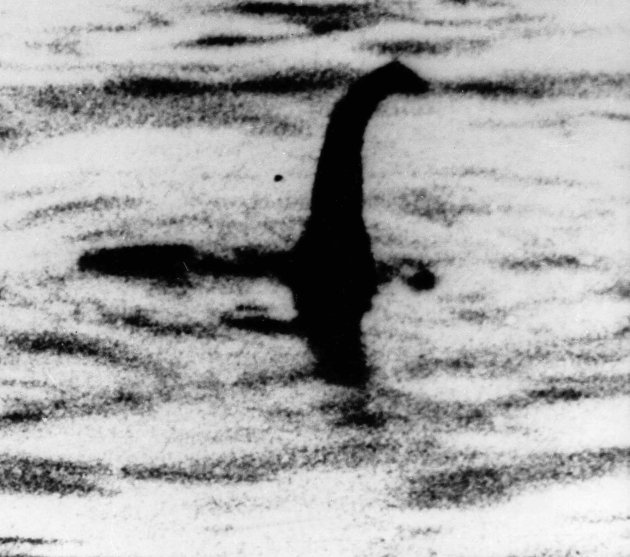
"An alleged photo of the Loch Ness monster in Scotland. (Associated Press)"


It's true!

"It sounds like a hoax, but it's apparently true: The Loch Ness Monster is on the science class syllabus for kids at Eternity Christian Academy in Westlake, Louisiana.

As reported by the Herald Scotland (which must track all Loch Ness-related news), a school that will receive tax-payer dollars, will teach kids that the mythological sea creature is real in order to debunk the theory of evolution. So pay attention: That will be on the test.

Eternity Christian Academy uses the  fundamentalist A.C.E. Curriculum to teach students "to see life from God's point of view."

According to the Herald, one textbook, Biology 1099, reads, "Are dinosaurs alive today? Scientists are becoming more convinced of their existence. Have you heard of the 'Loch Ness Monster' in Scotland? 'Nessie' for short has been recorded on sonar from a small submarine, described by eyewitnesses, and photographed by others. Nessie appears to be a plesiosaur."

Starting in the fall, thousands of schoolchildren will receive publicly funded vouchers to attend private schools, some of which are religious. Religious schools in Louisiana will receive public funding as part of a push from Louisiana's governor, Bobby Jindal, to move millions of tax dollars to cover tuition for private schools, including small bible-based church schools. Money will fund schools that have "bible-based math books" and biology texts that refute evolution.

At Eternity Christian Academy, pastor-turned-principal Marie Carrier says that the her first through eighth-grade students learn at their own pace from Christian workbooks.  The beginning science text explains "what God made" on each of the six days of creation. Evolution is not taught.

Carrier said, "We try to stay away from all those things that might confuse our children." She hopes to secure enrollment of 135 voucher students for the 2012-2013 school year. According to the website Salon, the school currently has just 38 students.

Whether this gambit will help move Louisiana from the bottom of math and science rankings in the country is unclear. A 2011 study of how well primary education prepares students for engineering careers had Louisiana third from the bottom, with only West Virginia and Mississippi performing worse." -Yahoo News

Wow.

Friday, June 15, 2012

Mammoths Wiped Out By Multiple Killers


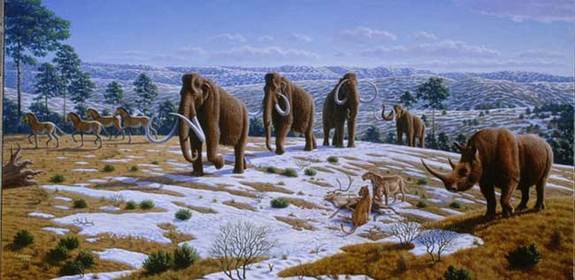
"Woolly mammoths were apparently driven to extinction by a multitude of culprits, with climate change, human hunters and shifting habitats all playing a part in the long decline of these giants, researchers say.

Woolly mammoths (Mammuthus primigenius) wandered the planet for about 250,000 years, ranging from Europe to Asia to North America covered in hair up to 20 inches (50 centimeters) long and possessing curved tusks up to 16 feet (4.9 meters) long. Nearly all of these giants vanished from Siberia by about 10,000 years ago, although dwarf mammoths survived on Wrangel Island in the Arctic Ocean until 3,700 years ago.

Scientists have often speculated over what might have driven the mammoths to extinction. For instance, for years researchers suspected that ancient human tribes hunted the mammoths and other ice age giants to oblivion. Others have suggested that a meteor strike might have drastically altered the climate in North America about 12,900 years ago, wiping out most of the large mammals there, the so-called "Younger Dryas impact hypothesis."

Now an analysis of thousands of fossils, artifacts and environmental sites spanning millennia suggest that no one killer is to blame for the demise of the woolly mammoths."

See here for more:

http://news.yahoo.com/mammoths-wiped-multiple-killers-150811751.html

Mysterious Bones May Belong to John the Baptist?


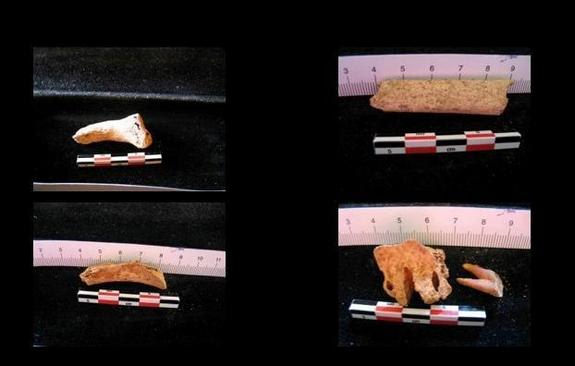
"A small handful of bones found in an ancient church in Bulgaria may belong to John the Baptist, the biblical figure said to have baptized Jesus.

There's no way to be sure, of course, as there are no confirmed pieces of John the Baptist to compare to the fragments of bone. But the sarcophagus holding the bones was found near a second box bearing the name of St. John and his feast date (also called a holy day) of June 24. Now, new radiocarbon dating of the collagen in one of the bones pegs its age to the early first century, consistent with the New Testament and Jewish histories of John the Baptist's life.

"We got some dates that are very interesting indeed," study researcher Thomas Higham of the University of Oxford told LiveScience. "They suggest that the human bone is all from the same person, it's from a male, and it has a very high likelihood of an origin in the Near East," or Middle East where John the Baptist would have lived."

See more here:

http://news.yahoo.com/mysterious-bones-may-belong-john-baptist-230719990.html

Nazi beach resort an unwieldy legacy for Germany


"It is one of the biggest relics left behind by the Nazis, perched on one of Germany's most spectacular beaches, and after years of neglect it is getting a new lease of life.

The historic dormitory complex at Prora, built between 1936 and 1939, sprawls nearly five kilometres (three miles) along a choice slab of Baltic Sea coastline.

Built as one of the so-called Strength Through Joy camps set up by the Nazis for the party faithful, it was to sleep up to 20,000 Germans in a pioneering attempt at mass tourism 300 kilometres north of Berlin.

The drive to offer recreation and hearty exercise was coupled with a desire to build loyalty and devotion to the Nazis among the working class, with ideological teaching on site.

The complex was to include a cinema, a theatre, a banquet hall for 25,000 people and two swimming pools.

But World War II put an end to the scheme and work was never completed.

When the Soviet army seized control of eastern Germany at the end of the war, the camp was turned to military use and did not appear on travel maps."

For more of the article, please see here:

http://news.yahoo.com/nazi-beach-resort-unwieldy-legacy-germany-074415688.html

Has a New Ten-Legged Species Evolved Beneath Rome?

"Crabs are alien. Their eyes stand up on stalks, waving without apology. Their ten legs each grasp the world, but mostly they keep to their realms of tidelands and sea bottoms. The river crab, Potamon fluviatile, sneaks along streams throughout much of Italy, Greece and nearby Malta, Albania, Croatia and Macedonia. It is, as crabs go, both interesting and ordinary. It is one of the crabs Aristotle would have seen, Homer too. It is a crab millions of children have grown up running from and toward screaming regardless of the direction. It is not a crab about which one hopes to make new discoveries; then someone did.

People have been keeping an eye on the river crab because like many species of crustaceans and nearly everything else in rivers and streams, its populations have been declining. We do terrible things to rivers and the species living in them. You have seen some of those things, and unfortunately, we do them nearly everywhere. Drop something into a river and it seems to disappear, and so we have dropped, dumped, poured and otherwise contaminated nearly every river in the world. In the Mediterranean we have been doing these things for thousands of years, especially in cities. As a consequence, crabs have gone locally extinct from most of the urban areas where they once lived.

Personally, I like crabs. You could not invent them if you did not know they existed. They are just a little too odd. Insects make do with six legs but crabs seem to need an extra set. And then there are their eyes, which might as well be legs the way they can look up and around corners. They gather what falls toward them. Those humans interested in rebirth seem to like the idea of being reborn as tigers or eagles but by my accounting, a great many bodies are reborn as crabs.

They have their weaknesses though, their tragic failings. Males of some crabs fight with claws so oversized they seem dysfunctional for other tasks. Then there is the way they move; it is all their own. Some can swim, sure. Others can hop a bit, but the movement that belongs to the crabs is the one that is named for them. It does not mean anything to ant or to beetle though you can certainly crab along or move crabwise.
But the real joy of crabs is walking along a shore and chasing them with your kids. The real joy of crabs is having them run over your feet. The real joy of crabs is that they exist and might just pop out of the hole you happen to have found on the shore or, in the case of the river crab, along some lovely bank. For all these reasons, when crabs disappear from rivers or shores, I think something more than a species is lost; we lose a whole kind of being. Once crabs are gone, children just chase each other. Once the crabs are gone, crabbing stops being a way of walking and just becomes a complaint. Without real crabs, the only things left crabbing are our neighbors. The crabs don t crab and somehow we are all lesser for it.

Then there is Rome. It came as a surprise to the world of crab-loving people (though perhaps not crab-loving Roman children) when in 1998 Massimiliano Scalici and colleagues at the University of Rome Tre saw the river crab beneath their city, the biggest city in Italy and one of the biggest cities in the world. One imagines their first temptation was to catch them, which is ultimately what they did, some of them anyway. Where no crabs were thought to exist, Scalici and colleagues found hundreds, looking up at them out of their long, stalk-eyes. The crabs, for their part, appear to have been there quite a while, unnoticed, perhaps glad for it."

Read more of the article here:

http://news.yahoo.com/ten-legged-species-evolved-beneath-rome-204900660.html

Sunday, June 10, 2012

US Navy hopes stealth ship answers a rising China - AP and Yahoo News


SINGAPORE (AP) — A super-stealthy warship that could underpin the U.S. navy's China strategy will be able to sneak up on coastlines virtually undetected and pound targets with electromagnetic "railguns" right out of a sci-fi movie.

But at more than $3 billion a pop, critics say the new DDG-1000 destroyer sucks away funds that could be better used to bolster a thinly stretched conventional fleet. One outspoken admiral in China has scoffed that all it would take to sink the high-tech American ship is an armada of explosive-laden fishing boats.

With the first of the new ships set to be delivered in 2014, the stealth destroyer is being heavily promoted by the Pentagon as the most advanced destroyer in history — a silver bullet of stealth. It has been called a perfect fit for what Washington now considers the most strategically important region in the world — Asia and the Pacific.

For more of the article, please see here:

http://news.yahoo.com/